
Shared Frequency Domains
The Bureau Bulletin By Melissa Madrigal
March 2026
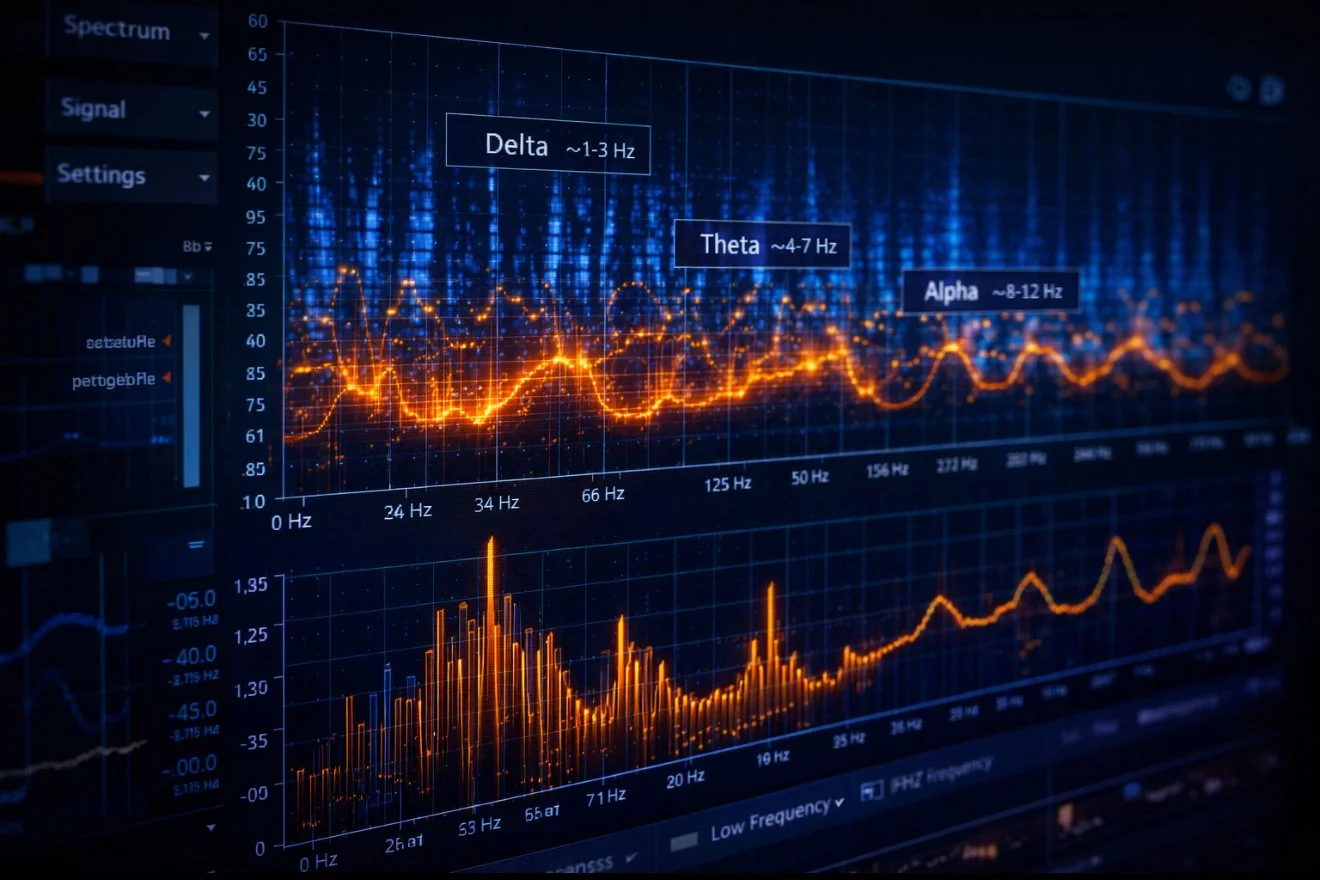
Across modern neuroscience, aerospace engineering, and geophysics, one principle appears again and again: systems organize and respond through frequency.
The human brain operates through oscillatory activity that can be measured in precise frequency bands. Delta rhythms occur between roughly 1-3 Hz. Theta occupies approximately 4-7 Hz. Alpha spans 8-12 Hz. Gamma oscillations extend into the 30-100 Hz range. These are not abstract concepts. Scientists record them, map them, and even manipulate them in clinical and research settings.
In recent years, controlled studies have shown that stimulating the brain at 40 Hz can alter biological markers linked to neurodegenerative disease in animal models. This work is not speculative. It shows that specific frequency states are associated with measurable physiological changes. Frequency, in other words, is not metaphorical. It has functional effects. This principle extends beyond biology.
Across modern technology, information travels not as matter but as structured oscillation in electromagnetic fields. When a switch is flipped, electrons do not rush from one end of a system to the other at light speed. Instead, changes in the electric field propagate nearly instantaneously through the circuit. Radio, Wi-Fi, visible light, and radar differ only in frequency. They are all forms of the same phenomenon: oscillating electric and magnetic fields that encode and transmit information across space.
From 60 Hz power grids to gigahertz wireless signals, engineered systems show that frequency is not abstract. It is measurable. It shapes how energy and information move.
The Earth itself has measurable electromagnetic background activity. Aircraft electrical systems commonly operate at 400 Hz for efficiency and weight reduction. Power grids operate at 50 or 60 Hz depending on region.
Across physics, harmonic systems follow a simple mathematical relationship:
Fₙ = n · F₀
From vibrating strings to electromagnetic systems, fundamental frequencies produce harmonic series. This is structural mathematics.
Seen this way, frequency becomes a unifying framework rather than a niche concept. Mechanical, electrical, and biological systems all operate within defined frequency ranges. Some operate at high frequencies. Others at low. Many exhibit layered oscillations across multiple bands at the same time.
In recent analytical work on UAP case studies, repeatable low frequency signatures have been identified across independent recordings. These patterns appear structured rather than random. They occur in frequency ranges that overlap bands already studied in biology.
It is important to be precise here. Overlap does not imply causation. The presence of a frequency within a biologically relevant range does not, by itself, demonstrate interaction. Environmental systems, atmospheric phenomena, and mechanical sources can produce emissions across broad ranges. Discipline requires that interpretation stay grounded in what can be measured and replicated.
However, convergence in frequency ranges is not meaningless. If anomalous craft emit structured signals within biologically relevant bands, then models of interaction may need to consider resonance, not just propulsion. Traditional aerospace analysis focuses on thrust, lift, materials, and energy sources. But frequency behavior is also a measurable property of physical systems. Ignoring it limits the scope of investigation.
This does not mean shifting research toward speculation. It means expanding instrumentation, refining spectral analysis, and treating frequency structure as a legitimate part of UAP investigation.
Across neuroscience, quantum sensing, and electromagnetic engineering, frequency is a core way systems are described and understood. It shapes synchronization, coherence, and energy transfer. If UAP phenomena exhibit structured frequency signatures, then those signatures deserve the same level of careful analysis applied to any other measurable signal.
Responsible research requires restraint. It also requires curiosity guided by disciplined methods. Frequency overlap between environmental, biological, and anomalous systems does not answer the larger question of origin. But it may help us understand how those systems operate.
As UAP investigation evolves, separating signal from noise remains essential. Equally important is recognizing when measurable patterns appear across different fields of study. When frequency ranges converge, the appropriate response is neither dismissal nor exaggeration. It is study.
The future of serious UAP research may depend not only on what we see in the sky, but on how precisely we measure what those observations emit.
###

To Contact Melissa:
Melissa Madrigal is the Director of Research for the International UFO Bureau (IUFOB), where she leads advanced investigations into electromagnetic signal patterns and harmonic fields associated with unidentified aerial phenomena.
The International UFO Bureau (IUFOB), founded in 1957, is a federally recognized 509(a)(2) nonprofit organization dedicated to the disciplined investigation of Unidentified Flying Objects (UFOs) and Unidentified Anomalous Phenomena (UAPs).
IUFOB preserves one of the nation’s longest-running UFO archives while applying modern analytical standards to current reports. Confidential sighting reports may be submitted at www.internationalufobureau.com.
The views and opinions expressed in this column are those of the author and do not necessarily reflect the official positions of the International UFO Bureau (IUFOB).
