
The Galileo Project is Now Capable of Discovering UAP
Boston, MA, March 16, 2026 – Editor’s Note: The article below comes from Avi Loeb. The piece ran on 3/2/26 and can be seen here: https://avi-loeb.medium.com/a-scientific-alternative-to-government-disclosure-the-galileo-project-is-now-capable-of-c859d4daf0b0
A few days ago, I celebrated my birthday by giving the colloquium at Harvard’s Institute for Thery and Computation, for which I served as director over the past twenty years. This hour-long lecture, available here, garnered nearly ten thousand views. It overviews the research performed within the Galileo Project that I am leading. The goal of the Galileo Project is to bring the search for extraterrestrial technological artifacts to the mainstream of transparent, validated and systematic scientific research.
The Galileo Project currently operates three observatories one in Massachusetts, a second in Pennsylvania and a third Nevada, with a future fourth observatory planned for Indiana. These observatories monitor the entire sky continuously in the infrared, visible, radio and audio bands, and record data on millions of objects. The data is analyzed by machine learning software, trained to discover outliers with unfamiliar characteristics.
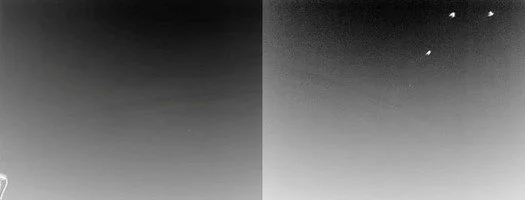
The same airplane is observed as a white dot in the lower-right quarter of the image on the left-hand-side and as a white dot near the center of the image on the right-hand-side (along with three birds flying above it). These two images were taken by two infrared cameras separated by about 10 kilometers. The comparison of the images, along with accurate time stamps, allows to infer the distance of the airplane to within an accuracy of better than 10%. (Image credit: Regina Sarmiento, Galileo Project)
For the first time since I co-founded the Project together with Dr. Frank Laukien in July 2021, the Galileo research team under my leadership has reached a major milestone this month. We are now capable of measuring distances to objects in the sky to better than 10%, by observing them from different directions with multiple units separated by 10 kilometers from each other. This method of triangulation, enabled by accurate time stamps, allows us to measure the three-dimensional velocity and acceleration of objects and determine whether any of them lies outside the performance envelopes of human-made technological objects, such as drones, balloons, airplanes, helicopters or satellites.
The goal of the Galileo research team is to figure out whether there are extraterrestrial technological visitors in our backyard. As of now, the Galileo observatories can discover Unidentified Flying Objects (UFOs) or Unidentified Anomalous Phenomena (UAP). Any such discovery, substantiated by scientific-quality data, will be shared through the standard scientific protocol with the public. Instead of waiting for disclosure of classified information on UAP or UFOs, the Galileo research team is simply observing the sky.
We do not need to rely on the official channels of NASA or the U.S. government to tell us whether we are being visited, for the same reason that we did not need the official declaration of the Vatican in 1992 to learn that the Earth moves around the Sun. The Vatican’s official announcement came 382 years after Galileo Galilei reached the same conclusion by looking at the sky through his telescope.
For 65 years, the SETI community has been searching for an electromagnetic signal from a distant star system while stubbornly avoiding the search for interstellar visitors near Earth — including a ban on discussing anomalous near-Earth objects at their conferences (as recommended by a committee chaired by Dr. Jason Wright from Penn State University). During the same period of time, the Pentagon and the U.S. intelligence agencies searched the sky for any flying objects from adversarial nations. These government agencies could have therefore been the first to record anomalous objects in the Earth’s atmosphere.
Mainstream astronomers are focused on the search for the chemical fingerprints of microbes in the atmospheres of exoplanets. Indeed, microbes are likely to be far more abundant than intelligent beings, but their chemical fingerprints are challenging to detect unambiguously. It makes sense to harvest low-hanging fruits in our backyard while we invest ten billion dollars in the Habitable World Observatory over the next two decades. This sounds like common sense, but common sense is not always common in academia.
A popular misconception is that interstellar travel requires advanced technologies. But a simple calculation that I posted here with my Harvard College student Shokhruz Kakharov, shows that our own Voyager spacecraft will reach the opposite side of the Milky-Way galaxy relative to the Sun in about a billion years. Given that most stars formed billions of years before the Sun, there was plenty of time for extraterrestrial artifacts to reach our backyard, even if aliens used the 1970s technologies that we employed to launch the Voyager spacecraft to interstellar space.
What data does the U.S. government store in its classified archives? We do not know. But two weeks ago, former President Obama and current President Trump referred to UAP as real and potentially linked them to aliens. I was delighted to read the following statement of President Trump here: “Based on the tremendous interest shown, I will be directing the Secretary of War and other relevant departments and agencies to begin the process of identifying and releasing government files related to alien and extraterrestrial life, unidentified aerial phenomena (UAP), unidentified flying objects (UFOs), and any and all other information connected to these highly complex but extremely interesting and important matters. GOD BLESS AMERICA!”.
The `Achilles Heel’ of past imagery and video data on UFOs or UAP, such as that presented in UAP congressional hearings over the past four years, is the unknown distances between the moving UAP and the moving cameras that recorded them. A nearby object might appear to move fast across the field of view even though its actual speed is modest. Knowing the time-dependent distances between multiple cameras and the object allows us to infer its three-dimensional velocity and acceleration. It is possible that undisclosed data from U.S. Government satellites can provide the velocity and acceleration of UAP relative to the ground, as indicated in 2021 here by John Ratcliffe — the current CIA director. I would be delighted to participate in a review board that analyzes any such data and reports back to President Trump about its implications.
The scientific research agenda of the Galileo Project is complementary to that of the Pentagon or the U.S. intelligence agencies. Whereas these agencies focus on human-made objects for the purpose of protecting national security, the Galileo research team is focused on non-human-made objects. I told the five new postdocs who joined the Galileo research team this spring that they should feel free to wake me up in the middle of the night if they detect a UAP which clearly deviates from the performance envelope of human-made objects.
Even if the Galileo research team does not find evidence for any extraterrestrial artifact, I will gladly share all lessons learned about the Galileo hardware, software and data with the Pentagon and the intelligence agencies, to help their mission in protecting national security.
However, if we do find evidence for an extraterrestrial artifact, mark my words: I will not waste any time in attending cocktail parties with the Nobel committee members in Stockholm but rather play the Bob Dylan card in ignoring the phone call from this committee. My time will be better spent in finding more details about our extraterrestrial visitors.
###
About the Writer:

(Image Credit: Chris Michel, National Academy of Sciences, 2023)
Avi Loeb is the head of the Galileo Project, founding director of Harvard University’s — Black Hole Initiative, director of the Institute for Theory and Computation at the Harvard-Smithsonian Center for Astrophysics, and the former chair of the astronomy department at Harvard University (2011–2020). He is a former member of the President’s Council of Advisors on Science and Technology and a former chair of the Board on Physics and Astronomy of the National Academies. He is the bestselling author of “Extraterrestrial: The First Sign of Intelligent Life Beyond Earth” and a co-author of the textbook “Life in the Cosmos”, both published in 2021. The paperback edition of his new book, titled “Interstellar”, was published in August 2024.
Professional website: https://lweb.cfa.harvard.edu/~loeb/
