
Is the Sunward Anti-Tail of 3I/ATLAS Composed of a Swarm of Objects?
Boston, MA, Dec. 8, 2025 – Editor’s Note: the article below by Dr. Avi Loeb originally appeared here: https://avi-loeb.medium.com/is-the-sunward-anti-tail-of-3i-atlas-composed-of-a-swarm-of-objects-55c3c75a8e9b
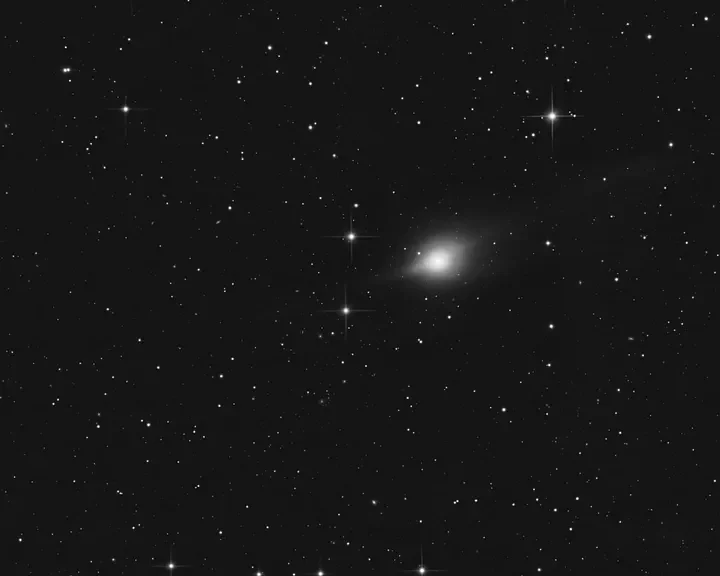
(NOTE: Above Image of 3I/ATLAS was taken on November 22, 2025 at 3:00–5:00 UTC based on stacking of 106 images of 60-second exposures, taken with a 0.30-meter telescope at Sternwarte Feuerstein (http://sfeu.de) in Germany. The image shows a teardrop shape of a coma with an anti-tail in the sunward direction, pointing towards the lower left corner. Image credit: Prof. Dr. Christina Birkenhake)
Over the month of November 2025, post-perihelion images of the interstellar object 3I/ATLAS showed a tear-drop shape of its coma with an extension by about an arcminute towards the Sun.
During the same period, the JPL Horizons tracking of 3I/ATLAS reported here a non-gravitational acceleration. Its magnitude is a small fraction, of order Δ=0.0002 of the gravitational acceleration from the Sun. In the latest version of JPL Horizons, the non-gravitational acceleration scales inversely with the square of the heliocentric distance (object-Sun separation), exactly as the Sun’s gravitational acceleration. This means that the ratio between the two accelerations remains constant along the orbit of 3I/ATLAS.
The dominant component of the non-gravitational acceleration is in the radial direction away from the Sun. A simple way to incorporate it is to consider 3I/ATLAS as accelerating in response to a slightly reduced mass of the Sun, by a fraction of Δ. If 3I/ATLAS is surrounded by a swarm of objects that do not share its non-gravitational acceleration, then these objects will tend to be closer to the Sun relative to 3I/ATLAS, because 3I/ATLAS is pushed away from the Sun relative to the objects through its non-gravitational acceleration.
Energy per unit mass is a conserved constant in trajectories shaped by the Sun’s gravity. However, the trajectory of 3I/ATLAS has a slightly smaller gravitational binding energy because of its reduced effective mass of the Sun. If the objects started at the same velocity and position as 3I/ATLAS, then they would have a surplus in gravitational binding energy by a fraction of Δ relative to 3I/ATLAS. However, they would have the same binding energy and track 3I/ATLAS if they have the same velocity and are displaced from its heliocentric distance by a fraction of Δ.
At the current separation of 3I/ATLAS from the Sun of 270 million kilometers, the displacement would imply that the objects are closer to the Sun than 3I/ATLAS by about 54,000 kilometers, corresponding to an angular separation of 0.7 arcminutes in the sky. This separation is comparable to the sunward elongation of the teardrop glow around 3I/ATLAS. As long as the objects do not experience non-gravitational acceleration from mass loss as a result of the solar illumination, they should maintain an anti-tail geometry — pointing always towards the Sun relative to 3I/ATLAS and converging to its location at perihelion.
A large swarm of objects would have a much larger surface area than that of 3I/ATLAS, even if the total mass in them is a small fraction of the mass of 3I/ATLAS. For example, a trillion (=10^{12}) objects carrying a total fraction of merely 0.001 of the mass of 3I/ATLAS would amount to a total surface area that is 100 times larger than that of 3I/ATLAS. This swarm would create the appearance of a coma that reflects 99% of the sunlight in the glow around 3I/ATLAS. This is consistent with the fraction of light in the coma within the image of 3I/ATLAS taken by the Hubble Space Telescope on July 21, 2025 (as analyzed here).
As long as the non-gravitational acceleration of 3I/ATLAS scales inversely with the square of heliocentric distance, the spatial extent of the objects would be of order Δ times the heliocentric distance of 3I/ATLAS, always pointing towards the Sun. This configuration would explain why the teardrop shape towards the Sun existed with a similar angular extent in the glow around 3I/ATLAS as it was approaching the Sun as well as it is now when 3I/ATLAS is moving away from the Sun. If the anti-tail is indeed associated with a swarm of non-evaporating objects around 3I/ATLAS, the interesting question is what is the nature of these objects? Are they rocky fragments or something else?
***
I recently received an uplifting message from a science teacher which read as follows:
“Dear Professor Loeb: I hope this message finds you well. My name is Joey Rotella, and I teach science at Eastdale Secondary School in Welland, Ontario, Canada. I wanted to reach out to express my appreciation for your work in the study of UAPs and related anomalous phenomena.
Your research has been the catalyst for some of the most meaningful discussions I’ve had with my students this semester. We’ve talked not only about the scientific questions themselves, but also about the broader idea that curiosity should not be restricted to topics that are already well-funded or socially comfortable.
I’ve shared with them the reality that scientists on the frontier of discovery often face cultural resistance, skepticism, and sometimes real professional risk. You’ve been an example I point to when we discuss the courage it can take to pursue truth rather than convenience. Many of my students had never considered that scientific progress sometimes begins with someone willing to ask an uncomfortable question.
I want to thank you personally for that. Your work has inspired me, and if I can pass even a fraction of that inspiration on to my students…if I can help even one young mind feel that curiosity is worth protecting…then it is absolutely worth the effort.
Please know that what you are doing is not only advancing a field, but also influencing classrooms like mine. You are, in the fullest sense, a role model for the next generation of scientists.
With respect and gratitude, Joey Rotella
Here’s hoping that Joey’s students will become scientists and solve some of the mysteries that my generation failed to understand.
***
ABOUT THE AUTHOR:

(Image Credit: Chris Michel, National Academy of Sciences, 2023)
Avi Loeb is the head of the Galileo Project, founding director of Harvard University’s — Black Hole Initiative, director of the Institute for Theory and Computation at the Harvard-Smithsonian Center for Astrophysics, and the former chair of the astronomy department at Harvard University (2011–2020). He is a former member of the President’s Council of Advisors on Science and Technology and a former chair of the Board on Physics and Astronomy of the National Academies. He is the bestselling author of “Extraterrestrial: The First Sign of Intelligent Life Beyond Earth” and a co-author of the textbook “Life in the Cosmos”, both published in 2021. The paperback edition of his new book, titled “Interstellar”, was published in August 2024.
