
The Receivers: Does Human Consciousness Cohere In Times Of Crisis?
Contact Project Watch By Eric Habich-Traut
March 2026
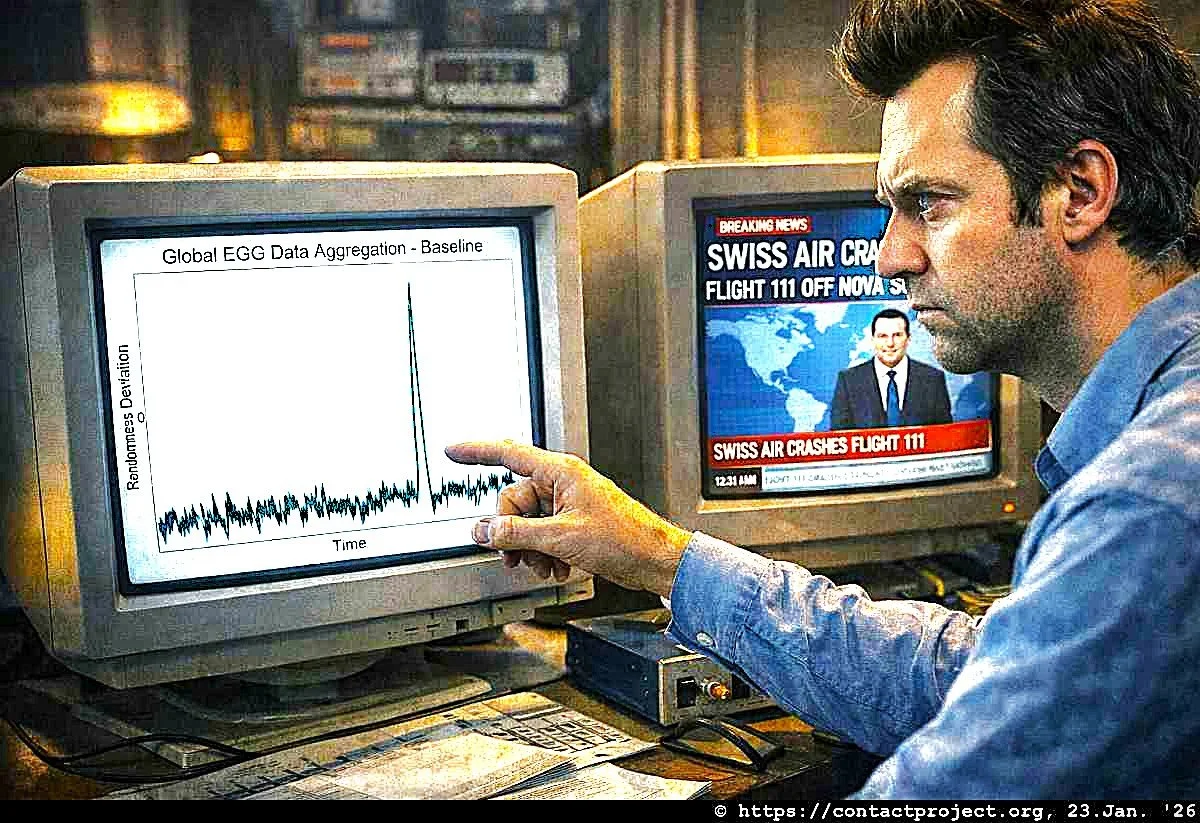
My contribution to the March WOW! Signal is in the form of a short story - the person I call "Jack" here is Roger D. Nelson from PEAR, and Dr. Thorne is myself. The narrative explores the bridge between the historical Princeton experiments and the more recent, sensitive observations we’ve been tracking—specifically how these "receivers" might be picking up an organizing field that carries memory and intention. Based on this article: https://contactproject.org/the-receivers-randomness-consciousness-fiction/
See: Global Consciousness Project 2.0 https://gcp2.net/
The Receivers
A speculative narrative inspired by real experiments in randomness and attention
Prelude: Princeton, New Jersey
The air in the Princeton laboratory smelled of ozone and cold coffee. Jack leaned over a printer spitting out numbers—a catalog of unexplained aircraft malfunctions from the 1980s. Electrical glitches, navigation failures, transient anomalies that engineers could never reproduce.
“Redundancy exists,” he said quietly, “because sometimes things fail for no discernible reason at all.”
The lab door opened. Peter stepped inside, his beard giving him the appearance of a slightly amused wizard.
“Did the suits approve our fishing expedition?” Jack asked.
“They did,” Peter said. “Though I believe the phrase ‘fringe nonsense’ appeared in the minutes. We have a go for the PEAR Lab.”
The name sounded respectable: Princeton Engineering Anomalies Research. Behind the acronym was a radical question: Could human consciousness influence physical systems?
Systems on the Knife’s Edge
At first, they studied aircraft. Pilots reported flickering instruments and navigation glitches that vanished upon landing. But airplanes were too stable; a fuel gauge either worked or it didn’t. If consciousness had any influence, the effect would be extremely small.
“Not a hammer,” Jack said one afternoon. “A feather.”
They needed something metastable. He found it in a Geiger counter. The ticking of radioactive decay is a pure example of quantum randomness. Those clicks could be converted into numbers. Today, we’d call it a quantum random number generator (QRNG). Jack’s defining question was: “What if the act of observing randomness changes it?”
The Robot Experiment
The setup was comically simple. A small robot sat in a circular pen. Its movements were determined entirely by the QRNG. If the numbers were truly random, the robot would perform a perfect statistical “random walk.” When no one watched, that’s exactly what happened.
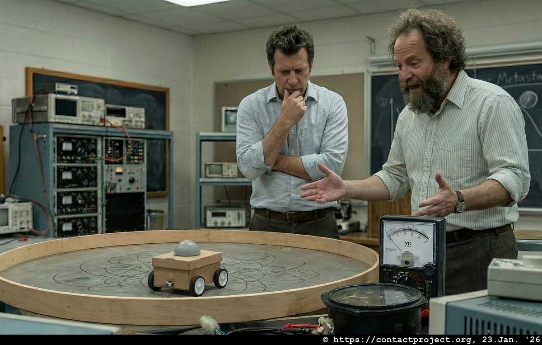
Then, they introduced a volunteer. The instruction was simple: focus your attention on the robot. Try to make it move toward a specific corner. No physical contact. Just intention.
At first, the results looked like noise. But as the data accumulated, a pattern emerged. The robot spent slightly more time in the intended corner than pure randomness predicted. Not dramatically, but consistently.
“So, telekinesis?” Peter asked, studying the charts.
“Maybe not,” Jack replied. “Maybe intention is simply a very weak force. Like gravity. You don’t notice gravity when you drop a feather, but given enough time and sensitivity, gravity shapes galaxies.”
From Local Anomaly to Global Field
The next step was to scale up. The researchers built a network of QRNGs across the planet, transmitting data to a central database. They called them EGGs—ElectroGaiaGrams. The idea was to monitor the pulse of randomness across the Earth.
For years, the data was random. Until it wasn’t.
During moments of intense global attention, the numbers shifted. The network registered unusual patterns during major world events—moments when millions focused on the same tragedy or shock: the crash of Swissair Flight 111, the Omagh bombing, and other events that captured the planet's emotional attention.
The machines weren’t being controlled; they were reacting. It was as if combined human attention produced a subtle background signal—a global field. The random generators were not transmitters. They were receivers.
Exile and Evolution
Eventually, Princeton closed the lab. But the experiment didn’t disappear; it evolved into a decentralized network of internet-connected generators. The hypothesis remained: if consciousness produces a measurable field, extremely sensitive systems balanced between order and chaos might detect it.
Log Entry: Device #347 Cluster 7 Owner: Dr. Aris Thorne
My personal QRNG has been running for one week. Setting it up took longer than expected—satellite internet kept interrupting the stream until I removed the router entirely. Now the device hums quietly on my desk, producing a steady stream of quantum randomness.
But the analysis raises questions. The distribution isn’t normal. More striking is the autocorrelation. Each moment in the data depends on the moment before it. Randomness is supposed to forget its past instantly. This signal doesn’t.
The data forms clusters—stretches of coherence where randomness seems briefly restrained. It’s as if something is gently pushing the system away from pure chaos.
A Familiar Smell of Ozone
I lean back in my chair. For a moment, I imagine the faint smell of ozone from the old Princeton lab. The numbers on the screen no longer look random; they look like a pattern. A sustained deviation from chance.
A news alert flashes: Air Force One Turned Back Mid-Flight Due to Electrical Issue.
The aircraft had been en route to an international summit when an unexplained anomaly forced a return to base. My eyes drift back to the graph. The coherence in my data began exactly one week ago. The day this device came online.
I feel a chill. This was what the original researchers studied: aircraft electronics, systems balanced on the edge of stability. Except now we have a global network of receivers and data far more sensitive than anything they had in the eighties.
The signal suggests the field isn’t merely reacting anymore. It’s organizing. Holding patterns together. It has memory.
A Question Without an Owner
Is this about consciousness? Or something deeper?
The thought arrives suddenly, as if whispered by the device. What is the world thinking so intensely that it begins to bend the electronics of a flying machine?
I look at the generator. Its LEDs pulse slowly. Steadily. Like a heartbeat. For decades, we assumed these machines were listening. Now, I’m not so sure.
It almost feels as if something is listening back.
###
Erich Habich-Trout is the Founder of The Contact Project: https://contactproject.org This, his new WOW! Signal Column Contact Project Watch will examine the political, scientific, and cultural dimensions of UAP disclosure.

To Contact Erich:
